
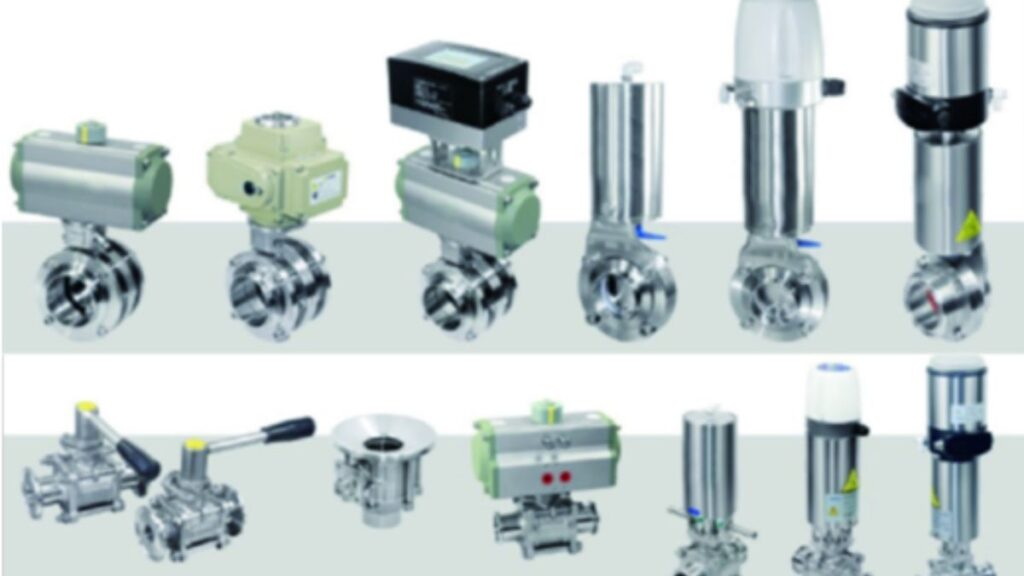
In the pharmaceutical industry, sanitary valves are critical components that ensure drug quality and patient safety. These valves must not only precisely control fluid flow but also meet stringent hygiene standards to prevent contamination, cross-contamination, and microbial growth. According to Good Manufacturing Practice (GMP) requirements, valve designs must ensure zero dead legs, easy cleaning, and corrosion resistance. Below are common types of sanitary valves used in pharmaceutical plants and their applications.
Diaphragm Valves: Guardians of Aseptic Production
Sanitary diaphragm valves are among the most common valve types in pharmaceutical plants. They use a flexible diaphragm to completely isolate the medium from the actuator, creating a dead-leg-free flow path. This design not only prevents contaminant retention but also ensures a fully sealed fluid channel.
In the production of biologics or injectables, diaphragm valves demonstrate unique advantages. The wetted parts are typically made of 316L stainless steel, with an electropolished surface achieving an ultra-smooth finish of Ra ≤ 0.8 μm, effectively preventing microbial adhesion. More importantly, diaphragm valves can withstand CIP (Clean-in-Place) and SIP (Steam-in-Place) processes, maintaining stable performance even in high-temperature steam environments up to 135°C. Modern diaphragm valves also come with sterile certifications, ensuring safe use in critical aseptic areas.
Ball Valves: Tools for High-Precision Control
Sanitary ball valves play a vital role in pharmaceutical processes. Unlike standard ball valves, sanitary ball valves feature a fully encapsulated design, achieving zero-clearance fit between the ball and seat. This structure not only ensures smooth media flow but also completely eliminates dead legs.
In applications such as active pharmaceutical ingredient (API) transfer and purified water systems, sanitary ball valves demonstrate exceptional sealing performance. Their quick open-close operation makes them particularly suitable for process steps requiring precise flow control. Modern sanitary ball valves often adopt a modular design, allowing for quick disassembly and maintenance, significantly reducing the risk of cross-contamination. Some specially designed ball valves also feature anti-misoperation functions, providing dual protection for critical processes.
Butterfly Valves: Optimal Choice for High-Flow Applications
For pharmaceutical processes handling large fluid volumes, sanitary butterfly valves offer an economical and efficient solution. Their slim design not only saves installation space but also maintains low flow resistance. The disc and seat of pharmaceutical-grade butterfly valves are specially designed to align parallel with the media flow when fully open, minimizing flow resistance.
In equipment such as large fermenters and batching systems, butterfly valves fully demonstrate their superior performance. Modern sanitary butterfly valves are typically equipped with visual position indicators, allowing operators to easily confirm valve status. Some high-end products also integrate smart control systems, enabling remote monitoring and automated management to meet the intelligent needs of modern pharmaceutical plants.
Check Valves: Barriers Against Backflow
In pharmaceutical fluid systems, sanitary check valves serve the crucial function of preventing media backflow. They employ a spring-assisted closing design to ensure rapid response to system pressure changes. Compared to traditional check valves, sanitary check valves feature an optimized internal structure that fully complies with 3-A sanitary standards.
Particularly in multi-product pipeline production scenarios, check valves effectively prevent cross-contamination between different batches of materials. Their compact design ensures system safety while maximizing space savings. Modern check valves also incorporate guided disc designs to ensure precise reseating under all operating conditions.
Control Valves: Key to Process Precision
In pharmaceutical processes requiring precise control of process parameters, sanitary control valves play an irreplaceable role. These valves regulate flow and pressure accurately through precision actuators and control systems, ensuring process stability and reproducibility.
In critical stages such as fermentation process control and clean steam regulation, the precision of control valves directly impacts final product quality. Modern sanitary control valves are typically equipped with sophisticated positioners and feedback systems, enabling real-time monitoring and adjustment of operating status. Their modular design facilitates easier cleaning and sterilization, fully complying with the strict hygiene standards of the pharmaceutical industry.
Conclusion
In pharmaceutical plants, the selection of sanitary valves directly impacts product quality and production efficiency. As the pharmaceutical industry’s quality requirements continue to rise, valve technology is also evolving. From material selection to structural design, from surface treatment to intelligent control, every detail reflects a commitment to drug safety and patient health. Proper selection and use of sanitary valves is not only necessary to meet regulatory requirements but also a reflection of pharmaceutical companies’ social responsibility.